
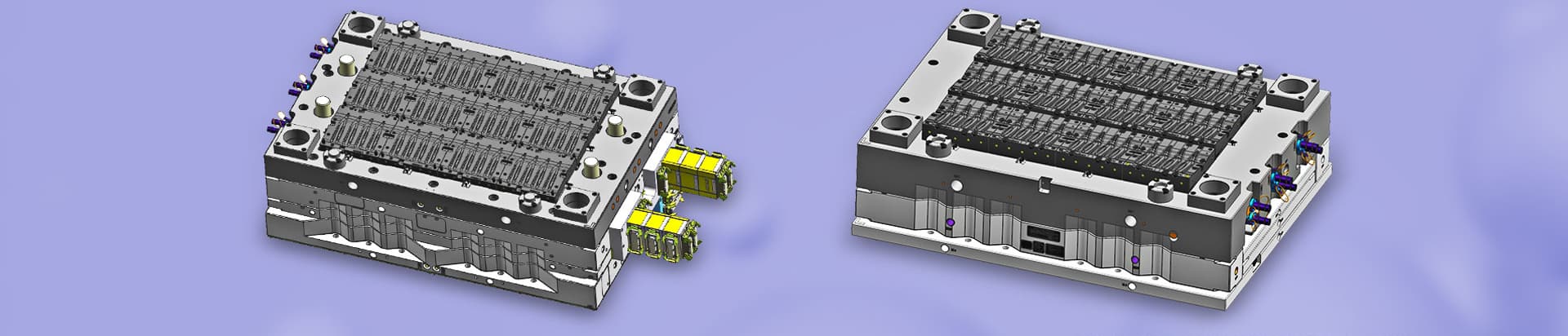
Filling is the first step in the entire injection molding cycle, which starts from the moment the mold is closed and continues until the mold cavity is filled to approximately 95%. In theory, the shorter the filling time, the higher the molding efficiency; However, in actual production, the molding time (or injection speed) is subject to many constraints.
During high-speed filling, the shear rate is relatively high, and the viscosity of the plastic decreases due to the thinning effect of shear, resulting in the overall flow of high-speed filling. The shear thinning effect of the melt is often significant, and the dynamic resistance of the thin wall is reduced; The local viscous heating effect can also cause the thickness of the cured layer to become thinner. Therefore, in the flow control stage, the filling behavior often depends on the volume size to be filled. In the flow control stage, the cooling effect is not significant, so the effect of velocity dominates.
When heat conduction is controlled for low-speed filling, the shear rate is low, the local viscosity is high, and the flow resistance is high. Due to the slow replenishment rate and slow flow of thermoplastic, the heat conduction effect is more obvious, and the heat is quickly carried away by the cold mold wall. Combined with a small amount of viscous heating phenomenon, the thickness of the solidified layer is thicker, which further increases the flow resistance at the thinner wall.
Due to the flow of the fountain, the plastic polymer chains in front of the flow wave are arranged almost parallel to the front of the flow wave. Therefore, when two plastic melt adhesives intersect, the polymer chains on the contact surface are parallel to each other; In addition, the two strands of adhesive have different properties (different residence times, temperatures, and pressures in the mold cavity), resulting in poor structural strength at the intersection of the adhesive at the microscopic level.
By placing the parts at an appropriate angle under light and observing them with the naked eye, it can be observed that there are obvious bonding lines, which is the mechanism of the formation of weld marks. The weld mark not only affects the appearance of the plastic part, but also has a loose microstructure, which can easily cause stress concentration and reduce the strength of the part, leading to fracture.
Generally speaking, the strength of weld lines produced in high-temperature zones is better. Due to the relatively good activity of polymer chains under high temperature conditions, they can penetrate and entangle with each other. In addition, the temperature of the two melts in the high temperature region is relatively close, and the thermal properties of the melts are almost the same, which increases the strength of the fusion zone; On the contrary, in low-temperature regions, the welding strength is poor.




 Call us on:
 Email Us:
 1st Floor, Block1, No.3 Beiting Road, Houting Community, ShaJing Street, Bao'An District, Shenzhen City, Guangdong Province, China
 English
 Deutsch
 italiano
 русский
 français
 română
 العربية
 Español
 Polska
 日本語
 한국어
