
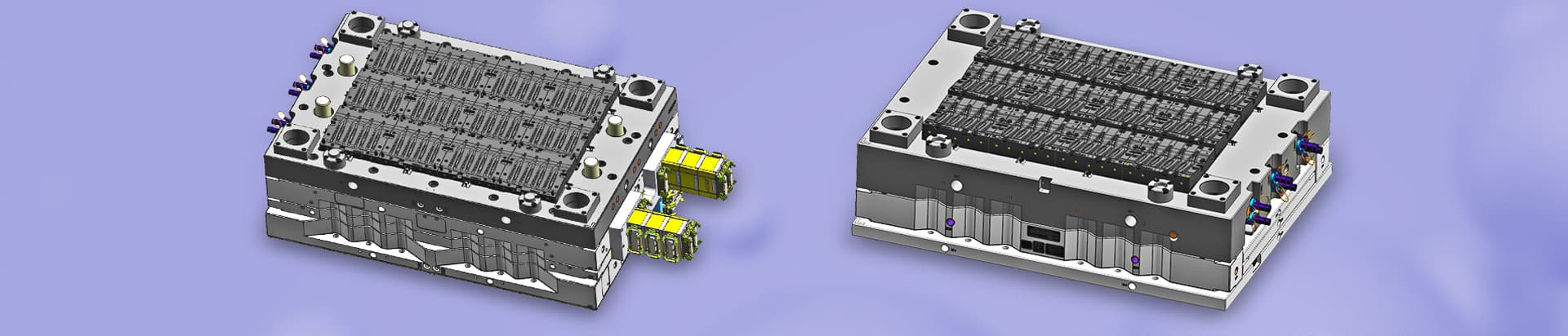
There is currently no unified standard for the range of values of draft angle, and the theoretical calculation is very difficult because it is difficult to establish a mathematical model of friction force. Different injection parameters can also affect the final results. Simulation calculations may obtain some reference values, but it is time-consuming and labor-intensive. Generally, mold factories do not have the strength and time to do it. They rely more on experience. As a structural engineer, it is necessary to understand this knowledge in order to consider draft angle for certain key structures in the structural design stage, reduce the number of feedback modifications by mold engineers, and avoid unnecessary trouble.
The characteristics of molding materials (hard plastics have a greater draft angle than soft plastics, and soft plastics may even have a strong pull-out)
Shrinkage rate (because the plastic with a higher shrinkage rate has a greater clamping force on the core, the plastic with a higher shrinkage rate should have a larger draft angle than the plastic with a lower shrinkage rate)
Friction coefficient (for some materials with low friction coefficients, such as PA and POM, the value of draft angle can be smaller than other ordinary plastics. The larger the friction coefficient on the surface of the product, the greater the draft angle. For example, the sun patterned surface requires a larger draft angle)
Wall thickness (when the wall thickness increases, the force of the plastic wrapping around the core is greater, and the draft angle should also be larger)
Geometric shape (for industrial plastic parts with complex shapes or more forming holes, a larger draft angle should be used, otherwise more ejector pins need to be arranged symmetrically and evenly to prevent uneven ejector force from causing part warping and deformation)
Transparent parts (parts with optical requirements should have a large draft angle)


 Call us on:
  Email Us:
  1st Floor, Block1, No.3 Beiting Road, Houting Community, ShaJing Street, Bao'An District, Shenzhen City, Guangdong Province, China
  English
 Deutsch
 italiano
 русский
 français
 română
 العربية
 Español
 Polska
 日本語
日本語 한국어
한국어