
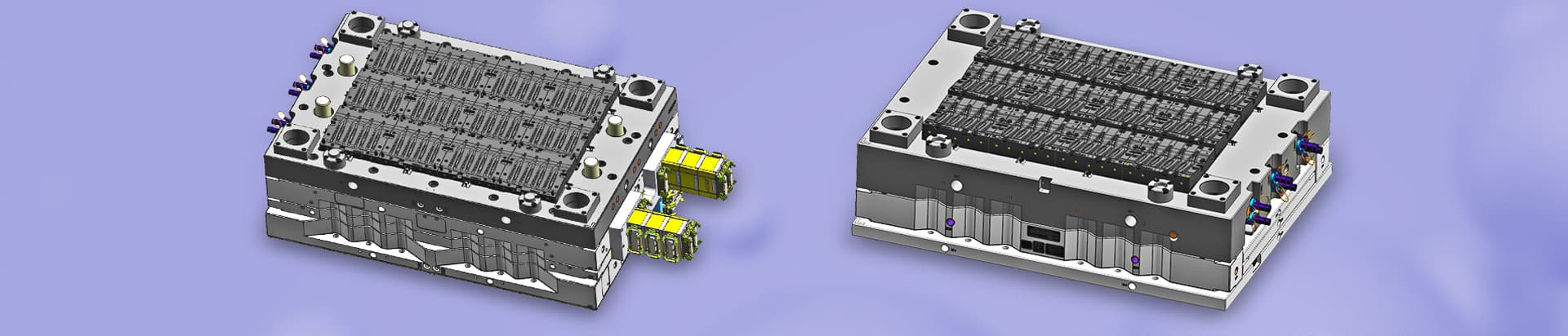
The diversion channel is a plastic passage that connects the main channel and the gate of the inner mold, allowing molten plastic to flow into the inner mold. A larger cross-sectional area is beneficial for reducing the flow resistance of the channel; a smaller cross-sectional circumference is beneficial for reducing the heat loss of molten plastic.
Circular cross-section flow channel:
The advantages are: minimal surface area, less heat loss, and low resistance.
The disadvantage is that it needs to be installed on both male and female molds simultaneously and must match each other, making it difficult to manufacture.
U-shaped cross-section flow channel:
The flow efficiency of U-shaped cross-section is lower than that of circular and hexagonal cross-section, but it is easier to process and easier to demold than circular and square cross-section channels. Therefore, U-shaped cross-section diversion channels have excellent comprehensive performance.
The above two cross-sectional shapes of flow channels should be preferred, followed by trapezoidal cross-sections. The slope of the waist of U-shaped and trapezoidal sections is generally 5–10 degrees.
The diameter of the flow channel is related to its length, and the longer the process, the larger the diameter.
Consider making the flow channel as thin and short as possible. The diameter of the flow channel is generally at least 1.0mm thicker than the finished rubber position to avoid the plastic in the flow channel solidifying before the finished product and unable to maintain pressure.
For commonly used mobile phone products with a wall thickness of 1.0–2.0mm, the diameter of the circular diversion channel used generally varies between 3.0–4.0mm. For plastics with good flow performance, such as PE, PA, PP, etc., when the diversion channel is very short, it can be as small as Φ2.5mm. For plastics with poor flowability, such as HPVC, PC, PMMA, etc., when the diversion channel is long, the diameter can be correspondingly increased.
Experimental results have shown that for most plastics, the diameter of the diversion channel has the greatest impact on flow when it is below 5–6mm. But when the diameter is larger than 8.0mm, increasing its diameter has little effect on improving the flow.
Generally speaking, in order to reduce the resistance of the flow channel and achieve normal pressure maintenance, it is required to: a. When the flow channel does not branch, there should not be a significant abrupt change in cross-sectional area. b. The minimum cross-sectional area in the runner is greater than the minimum cross-sectional area at the gate. For the three board mold, the above two points should be given special attention.
The design of multi-mode cavities must consider balanced inflow of melt, and the balanced flow channel arrangement enables each cavity to be filled simultaneously and have equal cavity filling pressure, resulting in similar performance and quality of the formed plastic parts. If the filling time in each cavity for the runner is not equal, it is necessary to change the gate size to accelerate the filling of the slower filled cavity, or change the runner radius to balance the pressure loss.





 Call us on:
  Email Us:
  1st Floor, Block1, No.3 Beiting Road, Houting Community, ShaJing Street, Bao'An District, Shenzhen City, Guangdong Province, China
  English
 Deutsch
 italiano
 русский
 français
 română
 العربية
 Español
 Polska
 日本語
日本語 한국어
한국어